Property Damage, Policing, and the Public Perception of Protests
Under Review
Abstract
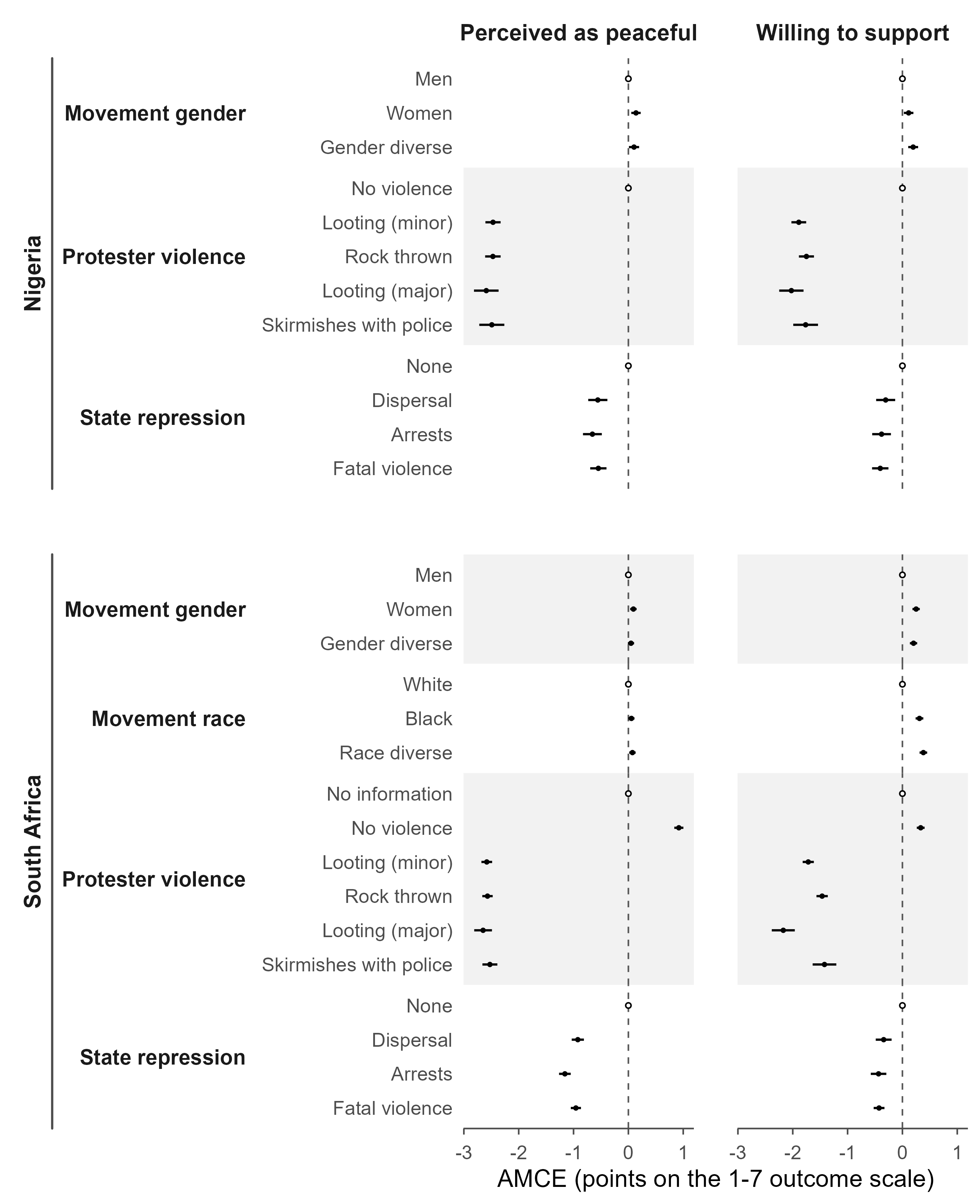
What drives public perceptions of protests as peaceful - or violent - and how do such perceptions impact popular support for movements? Substantial literature has long held that disciplined nonviolence is essential for conveying a movement’s commitment to peaceful action and thereby eliciting popular support. Relatedly, scholars contend that violent state repression of nonviolent movements often backfires, triggering moral outrage from bystanders and increasing popular support for the activists. However, recent studies have complicated these expectations, finding that protester demographics condition whether observers see protests as peaceful and repression as warranted. Using conjoint survey experiments in Nigeria, South Africa, and the United States, we jointly examine these dimensions of protest movements to test how public audiences react to who protests, what protesters do, and how the state responds. Three prevailing patterns drive public perceptions of peacefulness and support for movements. First, some protester demographics (gender, race where salient, but not age) have modest effects on audience attitudes. Second, these effects are significantly overshadowed by the effects of protester behavior: audiences are extremely sensitive to perceived disorder and respond negatively to even the slightest deviation from narrowly conceived nonviolent discipline, interpreting property damage as equivalently violent to interpersonal violence. Third, violent state repression is assessed to the movement, decreasing audience support and perceptions of protester peacefulness, even when movements assiduously maintain nonviolent discipline.